

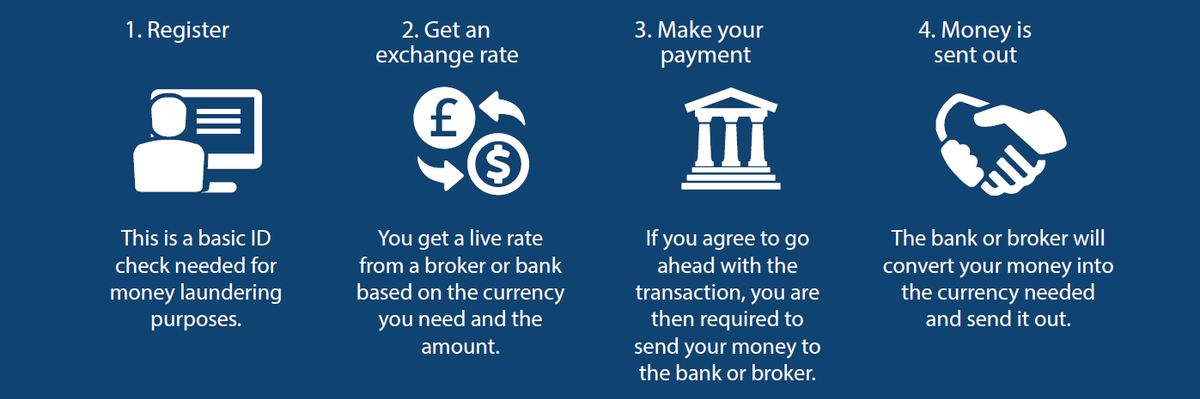
I’ll explain how you can transfer money from Italy to the UK in four basic steps.
The main thing is to avoid paying high bank charges along the way.
Alternatively, if you’re looking to transfer money to Italy from the UK, click through for information on that money transfer.
How to transfer money from Italy to the UK (in 4 basic steps)
Step 1 – Identity check
Financial regulations require an ID check for all new customers. This only has to be done once.
Most people can be verified using standard information such as passport number, date of birth, and address. It is generally a quick and easy process.
Step 2 – Lock in an exchange rate
To move money from Italy to the UK, you need to lock in a Euro to Pound exchange rate.
The rate changes every few seconds throughout the day – so getting a good rate can make a big difference to the number of Pounds you receive for your Euros.
A bank or money transfer specialist can provide you with their latest rates – but be aware there are no standard rates – they will vary depending on who you use.
Once you have received a quote if you are happy to go ahead, the rate agreed is locked in, and you will be emailed a confirmation with all the details.
Step 3 – Send in your Euros
Before any money is converted, you need to send in your Euros to pay for your money transfer.
Your email confirmation will include the details of where to pay your Euros.
Step 4 – Your Euros are converted into Pounds
Upon receipt of your Euros, your bank or money transfer company will convert them into Pounds and send them to the UK bank account you have requested. That’s it.
The best way to transfer money from Italy to the UK
To send money from Italy to a bank account in the United Kingdom you can use your bank or an independent money transfer service. Usually, a bank transfer is the best way to transfer your funds, it is cheaper and more secure than alternative payment methods (credit or debit card). An independent transfer provider will charge much lower fees and offer better exchange rates than your bank.
We’ve broken down the pros and cons below:
Pros | Cons | Best for | |
|---|---|---|---|
Bank | Can use your existing account | High charges, minimal help, daily limits | Small payments, convenience |
Money Transfer Specialist | Normally lower cost | Need to register first | Large or regular amounts (over €5,000) |
Costs compared: banks vs. money transfer companies
Whenever you make an international money transfer there are two charges to look out for:
- Transfer fees
- Exchange rates
The transfer fee is the more visible cost; however, the exchange rate cost tends to be of greater importance.
1. Transfer fees
Transfer fees tend to be a simple, flat fee that is charged for every international transfer you carry out.
Banks tend to charge them, but some money transfer companies do not.
The big Italian banks don’t make it easy to find out what transfer fees they charge.
Despite UniCredit and Banca Intesa having a Schedule of Tariffs that runs for 20+ pages, it seems to vary depending on the type of account you have. Not very helpful (or transparent).
That will tend to bite more for smaller or regular money transfers.
Banks also tend to charge more for priority transfers, as opposed to standard transfers. It’s just a way to extract another fee.
Most people don’t like paying fees, so if you want to avoid transfer fees, I suggest you use a money transfer specialist.
2. Exchange Rates
There is no such thing as standard exchange rates.
Every bank or money transfer company has its exchange rates, which is why it is important to shop around.
Banks typically offer some of the worst exchange rates in the market.
My reasoning is they rely on customers who don’t know they can go elsewhere.
That’s very high, in my opinion.
I would suggest you try a money transfer specialist and compare the costs.
I have no issue with the Italian banks, but I can tell looking at their websites that foreign exchange is well down their list of priorities. It hardly gets a mention as a service.
In contrast, foreign exchange is the core service of a money transfer specialist.
And as a money transfer specialist has far lower overheads than the big banks, they can undercut them on margin and provide much better exchange rates.
The Euro to Pound exchange rate moves every few seconds, so you want to be comparing apples with apples.

Is there a limit on money transfers from Italy to the UK?
There are no legal restrictions on transferring money from Italy to the United Kingdom.
Italy has no foreign exchange controls – it’s part of the EU’s rules.
However, most of the big Italian banks impose daily limits for international money transfers even though they are not legally required to.
For example; Banca Intesa has a €50,000 daily limit for international transfers.
UniCredit doesn’t publish its daily limit, but it is likely to be at a similar level as the big banks tend to copy each other.
For larger money transfers, a daily limit can cause frustration. It costs you more in fees and takes up more time and hassle to get your transfer done.
Money transfer specialists don’t tend to have any daily limits.
If you are planning to transfer a large amount of money from Italy to the UK, you are best off using a money transfer specialist as it will be easier and more efficient.
Beware of ‘fake’ online exchange rates
A lot of the exchange rates you see online are ‘teaser rates’ designed to generate clicks.
By that I mean they are not available to customers.
They are essentially wholesale rates used by banks trading between themselves.
It can be tricky for a customer to navigate their way through the smoke and mirrors of comparison sites and free forex websites.
While the internet is a great source of information, it is also a great source of misinformation.
The truth is usually buried in a cleverly worded disclaimer.
If you want a genuine exchange rate so you can budget your money effectively, I would suggest getting a quote from an actual provider of foreign exchange.
How to get the best EUR/GBP exchange rate
When transferring money from Italy to the UK, achieving a good Euro to Pound exchange rate is important.
Even small, fractional moves in the rate can make a big financial difference.
For example, if you were transferring say €50,000, even a tiny 2% improvement in the exchange rate could save you €1,000.
Swings of that size happen frequently – sometimes even within a single day.
Those 2% moves, even within a day, are easier to see on a live chart than in a single quoted rate.
EUR to GBP rate = 0.8332766
This data uses the mid-market rate. For an exchange rate on your money transfer, please get a transfer quote.
Use the buttons to see whether today’s euro to pound rate looks better or worse than it has over the past day, month, or year.
For someone unfamiliar with currency markets, it can be difficult to know when it’s a good time to exchange your money. A money transfer specialist can help you with this.
Some money transfer specialists, such as ourselves, can keep an eye on fluctuations in the rate for you.
This kind of service has become increasingly rare.
There are many online-only operators, such as PayPal, Wise, and Revolut, which offer “do-it-yourself” platforms or apps.
You have to enter all the information, press all the buttons, and make all the decisions.
They tend to be popular for micropayments and e-commerce merchants.
For larger international money transfers, many customers want the peace of mind of having someone that can offer expertise and a helping hand.
If the EUR to GBP rate moves in your favour or begins to go the wrong way, a money transfer specialist can alert you to opportunities or risks as they arise.
Getting some guidance on exchange rates could help optimise the timing of your transfer and ultimately, reduce your costs.